Your basket is empty
Looks like you haven't added anything to your basket yet




How Bake-O-Glide® Compares With Baking Paper And Parchment
Bake-O-Glide® is a reusable, non-stick liner that replaces baking paper, parchment, greaseproof paper and foil. Baking paper is used once, or a few times while it stays clean, and then binned.6 Bake-O-Glide® is washed and used again, and it is safe to 260°C (500°F / Gas Mark 8), where baking paper is typically rated to about 220°C.4 5
This guide compares the two on non-stick performance, heat, reuse, fit and cleaning, and says where paper is still the better choice. The numbered notes refer to the sources listed at the end.
Baking Paper, Parchment And Greaseproof Paper: What Is The Difference?
Baking paper, baking parchment and parchment paper are different names for the same product: paper treated with a thin food-grade non-stick coating, usually silicone.1 Greaseproof paper looks similar and resists oil and grease, but it has no non-stick coating, so it tends to stick when used for baking and needs generous greasing.1 2 Brands label their products differently, so the pack is the best guide.
Baking Paper And Parchment Compared With Bake-O-Glide® At A Glance
| Baking paper and parchment | Bake-O-Glide® | |
|---|---|---|
| Reuse | Used once, or a few times while it stays clean and intact6 | Washed and reused, designed for hundreds of uses if cared for correctly |
| Non-stick coating | Parchment: thin silicone coating. Greaseproof: none, so it needs greasing1 2 | PTFE coating, no greasing needed |
| Maximum temperature | Typically about 220°C4 5 | 260°C (500°F / Gas Mark 8)7 |
| Fit | Cut from a roll each time, and it can curl back up or slip around the tray4 | Cut once for each tin or tray, thin and flexible like paper |
| Cleaning | Nothing to wash, it is binned | Wiped, rinsed, washed in warm soapy water or put in the dishwasher |
| Best for | One-off bakes, wrapping food to cook en papillote, rolling pastry between sheets2 | Regular baking, awkward tins and higher oven temperatures |
Non-Stick Performance
Silicone-coated parchment is non-stick, and for most baking it works well.3
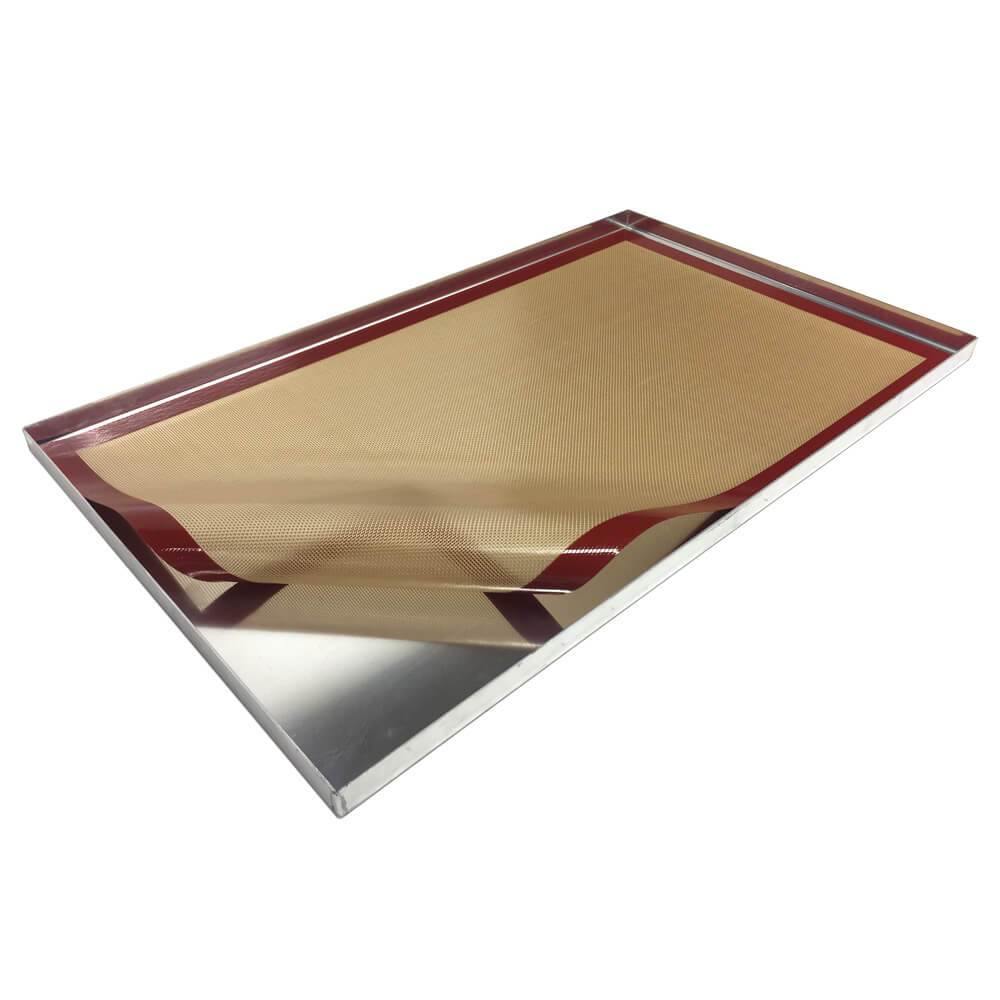
Bake-O-Glide® is a different material: woven glass fibre coated in PTFE.7 It is non-stick on both sides, and no fat, oil or grease is needed. Both are non-stick. What Bake-O-Glide® adds is reuse, more heat tolerance and a fit that is cut once.
Heat
Non-stick baking paper is generally heat-resistant to 220°C (200°C fan), and above this it tends to brown around the edges.2 Manufacturer ratings match: one well-known UK brand rates its non-stick baking paper to 220°C, and warns against contact with a naked flame, electrical heating elements or the sides of the oven.4 A German food-safety institute's recommendation for baking papers uses 220°C as the minimum the paper must withstand.5
Bake-O-Glide® is safe to 260°C (500°F / Gas Mark 8),7 which covers a fan oven on full or a hot roasting tin. It works in the oven, under the grill, in a frying pan, in the microwave, in an air fryer and on AGA and range cooker simmering plates. In an air fryer, the liner goes in only once the food is on top to weigh it down, and must be removed if food is not placed on top. It must never be used in an empty air fryer or during preheating, and it must not be placed directly on elements or flames.
PTFE falls within the broad PFAS classification used in current regulatory frameworks. Bake-O-Glide® states that restricted PFAS substances such as PFOA and PFOS are not used and are not present above current EU regulatory limits.7
Reuse
Baking paper can sometimes be reused a few times while it stays clean and undamaged,6 and the roll can run out on the day something needs baking. Bake-O-Glide® is designed to be reused hundreds of times if cared for correctly. It is non-stick on both sides, so either side can face up.
Fit
Paper comes off a roll, and each sheet is cut to the tin. It can curl back up or slip around the tray, which is why some brands now add a non-slip base.4 A liner is cut once. Sharp scissors trim it to a baking tray, cake tin, loaf tin or roasting tin, and the base of the tin makes a quick template. It is thin and flexible like paper, so it lies flat and folds into corners. For tins that are awkward to line, the pre-cut cake tin, sponge tin and loaf tin liners need no trimming.
Cleaning And Care
Paper has no wash-up, which is its genuine advantage. A liner needs a minute at the sink. It is wiped or rinsed after use, washed in warm soapy water, or put in the dishwasher, then dried and stored flat or loosely rolled.
Sharp implements and scourers, cutting food on the liner, creasing it, and direct contact with elements or flames are all best avoided. It darkens with use, which is normal and does not affect how it performs.
When Baking Paper Is The Better Choice
Baking paper is a perfectly suitable product for many bakers, and the comparison here is about specific use cases such as high-heat baking and regular reuse. For those jobs, paper remains the better choice:
- Wrapping food to cook en papillote, a use listed for non-stick baking paper2
- Rolling out pastry between two sheets2
- A one-off bake where you would rather bin the sheet than wash a liner
Which Bake-O-Glide® Liner Should I Choose?
- Cut to fit any tray or tin: the Original Cooking & Baking Liner comes in five sizes, from a 400 x 330mm sheet to a 1m x 1m square
- Ready to use from the pack: the Baking Sheets are a pack of two pre-cut 370 x 305mm sheets
- Circles, sheets and wall liners together: the Essential Baking Set
- For fatty or greasy roasts: the Roast & Grill Liner Sheet is laminated with PTFE, which makes it more resistant to oils and fats
If you are weighing a PTFE liner against a silicone mat, our PTFE or silicone guide explains the difference.
Frequently Asked Questions
Is Bake-O-Glide® the same as baking paper?
It does the same job of lining trays and tins, but it is a reusable PTFE-coated glass fibre liner that is washed and used again, instead of a paper that is used once or a few times.
Is baking parchment the same as baking paper?
Generally, yes. They are different names for paper with a thin non-stick coating, usually silicone.1 Greaseproof paper is different, because it has no non-stick coating.1
Do I need to grease Bake-O-Glide®?
No. No fat, oil or grease is required.
Can it go in the dishwasher?
Yes. It is dishwasher safe, or it can be washed in warm soapy water and dried.
How hot can it go?
260°C (500°F / Gas Mark 8).7 Baking paper is typically rated to about 220°C.4 5 Bake-O-Glide® should not touch direct flames or heating elements.
How many times can it be reused?
It is designed for hundreds of uses if cared for correctly.
Sources
Checked 1 October 2026.
- Nigella.com, Ask Nigella (cooking Q&A): Baking paper in recipes
- BakeClub, Anneka Manning (baking school founder, food editor and author of BakeClass), 2 April 2020: Baking Paper vs Greaseproof Paper
- America's Test Kitchen: Parchment vs. Silicone Baking Mat
- Bacofoil® (Melitta UK), Non-Stick Baking Paper, manufacturer's product information: Bacofoil Non-Stick Baking Paper
- German Federal Institute for Risk Assessment (BfR), Recommendation XXXVI/2, Papers, Cardboards and Boards for Baking Purposes (in German): BfR Recommendation XXXVI/2. English summary: SGS SafeGuardS, February 2023
- ZDFheute (German public broadcaster), consumer guide (in German): Backpapier und die Alternativen
- Bake-O-Glide®, Technical Information: Bake-O-Glide® Technical Information
- Choosing a selection results in a full page refresh.