Your basket is empty
Looks like you haven't added anything to your basket yet




PTFE vs Silicone for Commercial Baking: Which Should You Choose?
If you're buying baking liners for a bakery, confectionery or food production line, you'll hit the same question home bakers ask, just at a different scale: PTFE or silicone? Both give you a reusable, non-stick surface instead of parchment, and both are rated for thousands of bakes. The real decision comes down to finish, handling and how your kitchen actually works, not which material is objectively "better."
If you're choosing for home baking rather than commercial volume, our PTFE vs Silicone guide covers that decision instead. This one's for commercial kitchens or factories producing a much larger quantity than a home baker.
PTFE Liners
PTFE liners are thin, rated to 260°C, and give a smooth, glassy finish on the base of whatever you're baking. That matters for anything where the underside needs to look clean rather than textured, and for particularly sticky doughs or mixtures, since PTFE's non-stick coating has a slight edge over silicone for release.
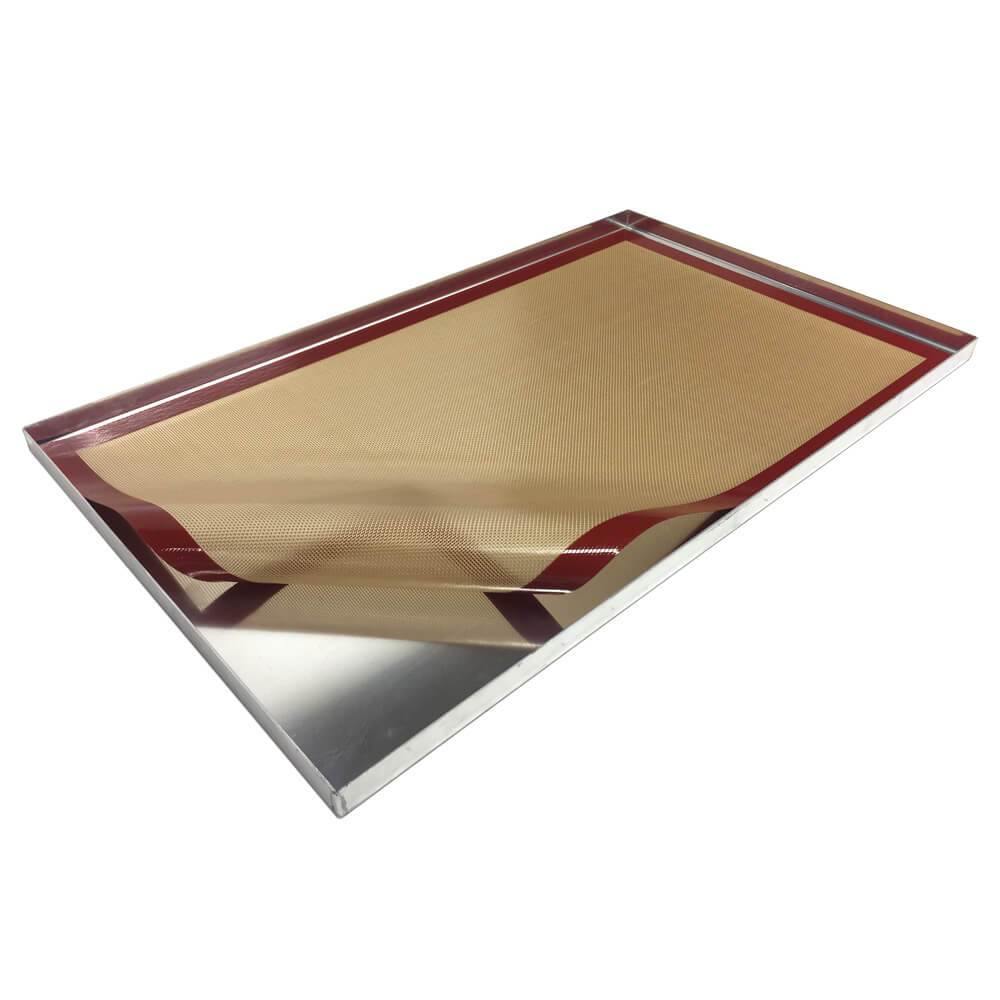
The other advantage is the flexibility a PTFE liner offers. If a tray or oven shelf doesn't quite match a standard size, a PTFE liner can be trimmed down to fit, and there's no real downside to doing it yourself. Silicone mats are different. They're usually made with a sealed, often coloured border, and cutting into that loses the seal, exposes the edge to fraying or damage, and tends to look messy rather than clean. Silicone only really works at the size it's made in for that reason. If you need a bespoke size that isn't in stock, PTFE also tends to have a shorter lead time than a custom silicone mat.
The trade-off is grip. PTFE's non-stick coating is slippery by nature, and that slipperiness doesn't stop at the liner, it affects what's sitting on top of it too. Turn away from an oven too quickly with a tray of cookies or sausage rolls on a PTFE liner and things can slide, sometimes straight off the tray, in a way they wouldn't on grease-proof paper. It's a habit thing as much as anything: teams used to paper don't always adjust their movements for how much less friction PTFE gives them, and it catches people out.
Silicone Mats
Silicone mats are heavier and have a grippier surface than PTFE, rated from -40°C to 250°C. That grip is the main practical advantage: PTFE's slippery coating can let whatever's on the tray slide about, or come off entirely, if you're turning or moving quickly. Silicone holds onto product far better, which matters most in a fast-paced service or a busy production line where trays are being spun round rather than carried carefully.
The trade-off is finish and flexibility. Silicone mats can leave a slight indentation pattern on the base of the product, bread and biscuits in particular. It's a minor cosmetic thing rather than anything that affects the bake, but if you need a completely smooth base, PTFE is the better choice. Silicone also only comes in the sizes it's manufactured in. It's usually finished with a sealed, often coloured border, and cutting into that loses the seal and risks fraying, so unlike PTFE it isn't something you can trim. You can, however, ask us for a quote on a bespoke sized silicone mat.
Worth knowing too: a silicone mat doesn't have to go anywhere near an oven to earn its keep. Its grip and non-stick surface make it a solid work surface in its own right for rolling pastry, working fondant or shaping dough, no flour needed underneath, and nothing sliding around while you work it. In a bakery, that means the same mat can do prep and bake duty, not just the bake.
What Doesn't Matter as Much as You'd Think
Both materials handle freezer temperatures fine at the bottom end, so cold storage isn't a deciding factor either way. And despite what you might read elsewhere, any difference in how the two materials conduct heat is negligible in practice, it's not something that will noticeably change how a bake turns out. What actually makes the difference is finish, handling, and how your kitchen works day to day.
PTFE and Silicone vs Parchment Paper and Disposable Liners
Worth putting next to the PTFE-or-silicone question is a bigger one: why use either instead of parchment paper or disposable liners at all? In a high-volume kitchen, the case for reusable liners has less to do with which material you pick and more to do with what you're moving away from.
Parchment paper curls at the edges, tears when you're moving a hot tray, and runs out mid-batch at the worst possible moment, usually meaning someone stops what they're doing to go and find another roll. Quality varies between suppliers and even between rolls from the same supplier, so non-stick performance isn't always consistent. None of that happens with a PTFE liner or silicone mat: it's the same surface, performing the same way, every single bake, and it's still there for the next one.
That consistency shows up in yield, not just convenience. Parchment that creases, tears or releases unevenly can mean a burnt base, a torn product, or something that sticks and comes apart on release, all of which is stock you can't sell. A PTFE liner or silicone mat releases the same way every time, so fewer bakes are lost to sticking or damage and more of what comes out of the oven is actually sellable.
There's a waste angle too. A busy bakery or production line can go through a genuinely large volume of parchment or disposable liners in a week, all of it binned after a single use. A reusable liner replaces hundreds of single-use sheets over its working life, which means less packaging coming in, less rubbish going out, and less time spent restocking consumables that a reusable liner or mat just doesn't need.
Here's how they stack up directly.
| PTFE Liner / Silicone Mat | Parchment Paper / Disposable Liner | |
|---|---|---|
| Reusable across hundreds of bakes | ✓ | ✗ |
| Consistent non-stick performance | ✓ | ✗ |
| Won't run out mid-service | ✓ | ✗ |
| Higher yield of sellable product | ✓ | ✗ |
| Minimal waste generated per shift | ✓ | ✗ |
Bringing It Together
There's no single right answer here, it depends on where you work and how you work. If you need a smooth, glassy finish, you're trimming to a non-standard size, or you're working with something particularly sticky, PTFE is the better fit. If you're moving fast and don't want product sliding or coming off the tray mid-service, silicone's grip earns its keep. Some kitchens simply stick with whichever material their team already knows and trusts, and that's a perfectly reasonable reason to choose one over the other too.
Whichever you use, never fold or crease either material for storage, roll or store flat instead, since a crease will stop it lying properly on a tray and create a point of weakness, where the coating is more likely to fail or become damaged.
PTFE vs Silicone at a Glance
Here's how the two compare side by side.
| Property | PTFE Liners | Silicone Mats |
|---|---|---|
| Temperature range | -40°C to 260°C | -40°C to 250°C |
| Finish on base | Smooth, glassy | Can leave a slight surface pattern |
| Non-stick strength | Slightly stronger, best for sticky mixtures | Strong, standard use |
| Sizing | Can be trimmed to fit, edges aren't sealed anyway | Fixed size only, cutting loses the sealed edge and frays |
| Grip during fast handling | Slippery, product can slide off if moved quickly | Grippier, holds product in place during fast service |
| Bespoke lead time | Shorter | Longer |
| Care | Warm water and detergent, or dishwasher | Hand wash only, not dishwasher safe |
| Storage | Roll or fold flat, never crease | Store flat or loosely rolled, never crease |
Which One Do I Need?
If you're weighing it up by situation rather than by property, here's the quick version.
| If you need | You want |
|---|---|
| A smooth, glassy base finish | PTFE |
| A liner trimmed to a non-standard tray size | PTFE |
| Release for particularly sticky doughs or mixtures | PTFE |
| Stability on flat or open-sided trays during a fast service | Silicone |
| Bread or biscuits with a completely smooth, unmarked base | PTFE |
| A bespoke size with a quick turnaround | PTFE |
| A stable worksurface that you can transfer directly to the oven | Silicone |
Frequently Asked Questions
Does silicone leave a mark on the base of what I'm baking?
It can leave a slight indentation pattern, most noticeable on bread and biscuits, but it's a minor cosmetic thing rather than anything that affects the bake. If you need a completely smooth base, use a PTFE liner instead.
Can I cut a silicone mat down to fit my tray?
No. Silicone mats are usually finished with a sealed, often coloured border, and cutting into it loses that seal and risks the edge fraying. By cutting into a silicone mat you will damage it. PTFE liners can be trimmed with no downside, since they're never sealed at the edge to begin with, which makes PTFE the better option for odd or non-standard tray sizes.
Can I get a bespoke size in either material?
Yes, both are available bespoke. PTFE tends to have the shorter lead time, since a standard liner can simply be trimmed to size. A bespoke silicone mat has to be made to that size from scratch, so it takes longer and needs a quote rather than an off-the-shelf order. Get in touch through our trade enquiries page for either.
- Choosing a selection results in a full page refresh.